
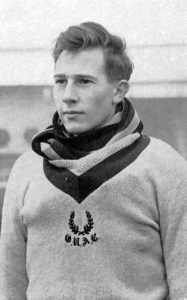
In 1952 Roger Bannister, a 23 year old medical student, was recognised as the best middle distance runner in Great Britain and as a very good prospect for the gold medal in 1500m at the Olympic Games which were to be held in Helsinki, Finland. He had gained a degree in Physiology from Oxford University where he had been president of the university athletic club. He was now studying to become a doctor at St Mary’s hospital in London. His heavy schedule of medical studies had left him with little time for training. He relied on his natural strength and strong final lap sprint to carry him through. However, the organisers arranged for the heats, semi-final and final to be run on consecutive days. Bannister was exhausted and came a disappointing fourth in the final.
Had he won the gold medal it is likely that he would have retired from running to concentrate on his medical career. He later became a distinguished neurosurgeon.
The disappointment of missing out on the Olympic title spurred Bannister to take on the greatest athletic challenge of his time – the attempt to break four minutes for the mile. The world record of 4min 1.4sec had been set in 1945 by the Swede Gunder Hägg. Many fine athletes had attempted the feat but no-one had come close to breaking Hägg’s record or the 4-minute mark which had become an iconic challenge. Bannister had broken the British record with a run of 4 min 3.6 sec and was now keen to take on the test. He was well aware that his great rival the Australian, John Landy, had recently run 4 min 2 sec in two races. He intensified his training.
He made his attempt at an athletics meeting in Oxford on 6 May 1954. It was a cold and windy day. He was assisted by two expert pacemakers, Chris Chataway, who later that year set the 5000m world record, and Chris Brasher, who won an Olympic gold medal in the steeplechase in 1956 in Melbourne. They established a steady pace over the first three-quarters of the race leaving Bannister to use his strong finish in the final quarter mile. His time was a new world record of 3 min 59.4 sec, the first time anyone had run under 4 minutes. His achievement was greeted with euphoria in Britain.
Hägg’s record had stood for nearly nine years. Bannister’s stood for just 46 days. Landy ran 3 min 58 sec in a race in Finland. The two great rivals met in the Commonwealth Games in Vancouver in August that year in what was billed as the “Mile of the Century”. There was tremendous anticipation over this encounter and it did not disappoint. Landy set off quickly trying to diminish the effect of Bannister’s strong sprint finish. The Austrlian led for three laps but Bannister overtook him in the final straight to win. Both men ran under 4 minutes.
Bannister’s final competitive race was later in August at the Europen Games in Berne. He won the 1500m in a championship record time. Then at the peak of his powers he retired from racing at the age of 25.
He had a distinguished career in medicine and made major contributions to academic research into the responses of the nervous system. In 1975 he was knighted. Ten years later he became Master of Pembroke College, Oxford, where he served until his retirement in 1993. He died in March 2018.
Sometimes a failure can be a blessing. If Bannister had won gold at the Helsinki Olympics and then retired he would now be forgotten. The disappointment of losing galvanised him into a greater effort and a place in history.
Some motivational speakers claim that when Roger Bannister broke the psychological barrier of the 4-minute mile in 1954 the floodgates opened and many other runners suddenly became capable of it. The actual number of runners (other than Bannister) who ran under 4 minutes in the year after the breakthrough was one – John Landy. Landy’s record of 3 min 58.0 stood for three years before being broken by Derek Ibbotson who ran 3 min 57.2 in 1957. The current world record is 3 min 43.1 sec held by the Moroccan Hicham El Guerrouj.


